


Views: 112 Author: Site Editor Publish Time: 2026-10-22 Origin: Site


Ever bought beautiful miniatures, only to find them awkwardly sized when placed among your potted ferns? Creating a realistic miniature garden is surprisingly tough. The secret to an enchanting, believable landscape lies entirely in precise scale and size.
In this comprehensive guide, we strip away the guesswork. You will learn the exact specifications needed to choose the perfect resin fairy figurines for your specific setup. By analyzing spatial volume and material integrity, we will guide you through matching these pieces seamlessly with your plants. The result? A magical world that looks highly intentional rather than chaotic.
Scale Dictates Realism: The most universally adopted scales for miniature landscaping are 1:12 (standard) and 1:24 (half-scale). Maintaining a consistent mathematical ratio prevents visual clutter.
Container Proportions: Micro-figurines (under 1 inch) are strictly engineered for enclosed terrariums. Conversely, 2.5 to 3.5-inch figures serve as the optimal structural choice for standard potted setups.
Material Durability: For outdoor environments, high-density polyresin offers the highest baseline of weather resistance, UV stability, and structural integrity compared to porous ceramics or brittle plastics.
Botanical Harmony: Always pair your accessories with slow-growing, dwarf plant cultivars. Applying the "rule of thirds" ensures aggressive foliage does not engulf the miniature scene.
Parameter Verification is Crucial: The term "miniature" is highly subjective. Always verify exact inch or centimeter dimensions and weight specifications before making a purchasing decision.
Achieving a cohesive and visually pleasing landscape requires strict adherence to scale. In professional landscaping and architectural design, scale refers to the proportional relationship between a model and its real-world counterpart. Mixing different scales in a single container creates a disjointed appearance that instantly breaks the illusion of reality.
Scale is expressed as a mathematical ratio. For example, a 1:12 scale means that one inch on the miniature figurine represents twelve inches (or one foot) in the real world. If a real-life human is theoretically 5.5 feet tall, a 1:12 scale model would be exactly 5.5 inches tall. Because fairies are traditionally conceptualized as smaller beings, a 1:12 scale fairy is typically engineered to be between 2.5 and 3.5 inches in height.
Sticking to a consistent scale allows you to accurately predict whether a miniature bench, a tiny cottage door, and your chosen figurines will look proportionally correct when installed next to each other on a mossy mound.
Before diving into specific sizes, it is crucial to understand where the market is heading. Recent search data and consumer purchasing behaviors reveal a massive shift toward all-weather, permanent miniature landscaping. Modern hobbyists are abandoning fragile, seasonal decor. Instead, there is a high demand for sustainable, UV-resistant pieces that can withstand year-round outdoor exposure. This trend heavily influences sizing, as gardeners now favor slightly larger, heavier figurines that offer better wind resistance and visual stability in permanent outdoor installations.
When browsing catalogs, you will encounter various size classifications. Knowing the physical dimensions, weight distribution, and logistical challenges of each size category is essential for making an informed structural choice.
Micro-figurines measure less than one inch in height. They are precision-crafted and are best utilized in closed glass terrariums, broken-pot vertical gardens, or desktop planters.
The primary challenge here is visibility. Due to their diminutive size, they are easily swallowed by standard potting soil or regular aquarium gravel. To make micro-figurines visible, you must use horticultural sand, finely sifted soil, and extremely low-profile ground covers like Scotch moss.
Ranging from 1.5 to 3.5 inches, this is the most versatile and widely manufactured size. It is engineered specifically for standard window boxes, medium terracotta pots (10 to 14 inches in diameter), and wheelbarrow gardens.
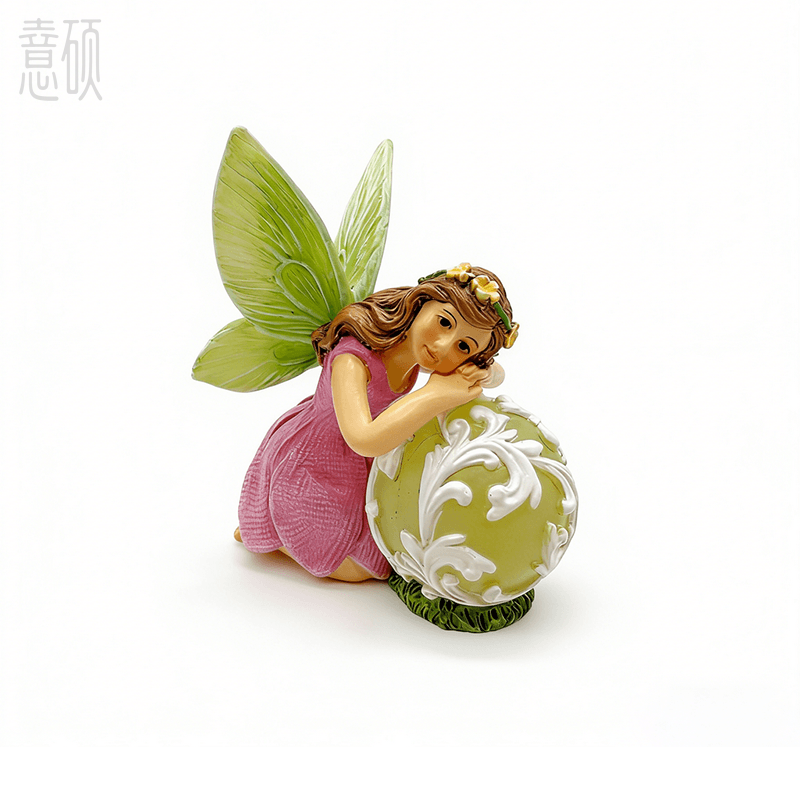
This is the sweet spot where you will find the highest quality miniature fairy figures. At these dimensions (typically around 3.15 x 2.5 x 3.5 inches), manufacturers can cast intricate details without compromising the structural durability required for garden use. Furthermore, a figurine weighing approximately 100-120 grams in this size range provides enough specific gravity to resist wind displacement without compacting the underlying soil.
Figurines exceeding 4 inches are classified as large or outdoor-scale. They are best deployed at ground level, nestled near tree stumps, or anchored along the borders of outdoor flower beds.
Standard outdoor garden foliage, such as hostas or ferns, will not obscure these larger figures. They serve as excellent focal points in a full-sized garden and feature a lower center of gravity, making them highly resistant to heavy rainfall and environmental wear.
Figurine Height | Scale Classification | Ideal Installation Environment | Max Plant Height (Rule of Thirds) |
|---|---|---|---|
Under 1 Inch | 1:24 or Micro | Glass Terrariums, Teacups | 3 Inches |
2.5 to 3.5 Inches | 1:12 (Standard) | 10-14" Pots, Window Boxes | 7.5 to 10.5 Inches |
4+ Inches | 1:6 (Play-Scale) | Ground-Level Garden Beds | 12+ Inches |
Selecting the right size is not just about the figurine itself; it is about calculating the spatial volume of the container holding it. A systematic approach to spatial design ensures that your miniature scene looks structurally sound and natural.
Terrariums are enclosed environments that retain high humidity. When selecting figures for these spaces, you must account for the vertical clearance of the glass dome. Always measure the internal height of your glassware. If the terrarium is 6 inches tall, a 3-inch figurine will consume 50% of the vertical space, causing visual overcrowding. Instead, opt for 1-inch figures and ensure the materials are non-porous to withstand constant moisture exposure without degrading.
For medium-to-large containers like half-whiskey barrels, 2.5 to 3.5-inch figurines are optimal. In these larger surface areas, apply the landscaping concept of "zoning." Divide the planter into distinct functional areas: a dense woodland zone using taller dwarf trees, a transitional pebble pathway, and an open clearing.
By installing your mini garden figurines in the open clearing, you create a natural focal point. When pressing a resin base of this size into the soil, leave a quarter-inch exposed. This prevents the figure from looking like it is sinking after soil compaction from heavy watering.
When integrating a miniature scene directly into the earth, the rules of scale shift. Ground-level environments expose installations to unpredictable elements: heavy rain, leaf litter, and local wildlife. Here, you must prioritize large, highly durable figures (4 inches or taller). A 2-inch figure placed in a standard garden bed will disappear behind a single fallen oak leaf. Larger figures anchor the scene effectively.
A recurring issue among hobbyists is rapid plant overgrowth. You may start with a perfectly scaled scene, only to find your carefully curated setup completely hidden by aggressive foliage weeks later. Plant selection must be as deliberate as figurine selection.
In miniature landscaping, the "Rule of Thirds" dictates the proportional relationship between the tallest plant (acting as the miniature "tree") and the primary figurine. For optimal visual balance, the figurine should be approximately one-third the height of the tallest plant. For example, if you are using a 3-inch fairy, your focal-point plant should be roughly 9 inches tall. This mimics the real-world proportions of a human standing beneath a mature tree.
To maintain scale over time, select slow-growing, dwarf, or alpine cultivars. Avoid fast-growing annuals that require constant pruning. Excellent botanical pairings include Dwarf Baby Tears (Soleirolia soleirolii) and Irish Moss (Sagina subulata).
Furthermore, to prevent your characters from being swallowed by foliage, establish a bi-weekly pruning schedule. For aggressive growers, plant them in their own sunken plastic nursery pots within the main container. This technique restricts root expansion and significantly slows the plant's overall growth rate, preserving the scale of your landscape.
Once you have determined the correct size, the next critical decision is selecting the right material. While the market offers plastic, ceramic, and metal, high-density polyresin consistently proves to be the superior choice for outdoor installations.
Outdoor miniature landscapes face constant environmental stress. Ceramic figures are highly porous. If left outside, ceramic absorbs moisture; when temperatures drop, trapped water expands, causing the figurine to shatter (freeze-thaw damage). Cheap plastics, conversely, become brittle under ultraviolet (UV) degradation and warp under summer heat.
High-quality polyresin solves these engineering flaws. It is a non-porous material, meaning it completely repels water. Premium resin is also highly resistant to UV degradation, maintaining its structural integrity in temperatures ranging from -10°C to 50°C (14°F to 122°F).
Beyond sheer durability, polyresin is exceptionally moldable in its liquid state. When poured into silicone molds, it captures microscopic details that other materials cannot achieve.
This level of precision is exactly why hand-painted resin fairies are the industry standard. The material allows for delicate textures, from the translucent veins in a fairy’s wings to intricate facial expressions. Because resin holds paint exceptionally well, these figures are finished with outdoor-grade, weather-resistant acrylics that bring long-lasting color to your garden.
Purchasing miniature accessories requires a careful, analytical approach. Because digital photographs lack physical context, it is incredibly easy to misjudge scale. Follow this objective checklist to ensure you invest in the right pieces.
The most common mistake is relying solely on product photography. E-commerce sellers frequently use macro photography to highlight painted details, which can make a half-inch micro-figure look like a substantial four-inch statue on your screen.
Never purchase an item based on an isolated photo. Always navigate to the product specifications and extract the exact physical dimensions (height, width, depth, and weight). Once you have those numbers, take a physical ruler and measure the actual container you plan to use.
If you are building a new arrangement, piecing together items from different manufacturers often leads to a disjointed landscape. A chair from one brand might be twice the size of a fairy from another brand.
To avoid this, purchase your fairy garden decor in pre-packaged sets. Reputable manufacturers design their collections with strict proportional harmony. By purchasing a complete set, you guarantee that the fairies, animals, and architectural elements are cast in the exact same mathematical scale.
The optimal figurine size depends entirely on your specific container volume, plant selection, and the mathematical scale you choose to follow. Measuring your pots carefully and applying the rule of thirds ensures a beautifully balanced, structurally sound landscape.
Always verify exact dimensions before purchasing, and prioritize high-density polyresin for maximum outdoor longevity. Ready to build a permanent, weather-resistant miniature landscape? Explore the premium, precisely scaled collections at xmideasource.com to find the perfect characters and accessories for your next garden project.
It is generally best to stick to one consistent scale per container to maintain a realistic illusion. However, advanced gardeners use a technique called "forced perspective." By placing slightly smaller figures in the far back of a deep garden bed, and larger figures in the front, you trick the eye into believing the space is much deeper than it actually is. If utilizing this method, the transition in size must be meticulously gradual.
While premium resin is naturally UV-resistant, continuous exposure to harsh, direct sunlight will eventually degrade any painted surface over several years. You can actively protect your investment by applying a clear, UV-resistant polyurethane craft sealer once a year. Additionally, positioning your figures in dappled-light areas, such as under the canopy of a larger dwarf plant, significantly extends the lifespan of the acrylic paint.
For standard 3-inch figurines, their inherent weight (approx. 120g) is usually sufficient for sheltered pots. However, in open garden beds exposed to high winds, stability is critical. You can secure them by adhering a 2-inch galvanized steel wire to the bottom of the resin base using outdoor-grade epoxy. Once cured, simply push the wire deep into the compacted soil to serve as an invisible ground anchor.
To ensure a 3-inch resin figurine remains upright during heavy watering or rain, your container should have a minimum topsoil depth of 2 inches. This allows you to press the base of the figurine approximately 0.25 to 0.5 inches into the soil, creating a secure "footprint" without burying the aesthetic details of the character's feet or base.
While high-density polyresin is highly resilient, it is not entirely immune to severe winter extremes. The primary danger is the freeze-thaw cycle. If moisture accumulates in the micro-crevices of the figurine and freezes, the expanding ice can cause the paint to chip. To preserve the structural integrity of your accessories, it is highly recommended to clean them and bring them indoors before the first hard frost.


